
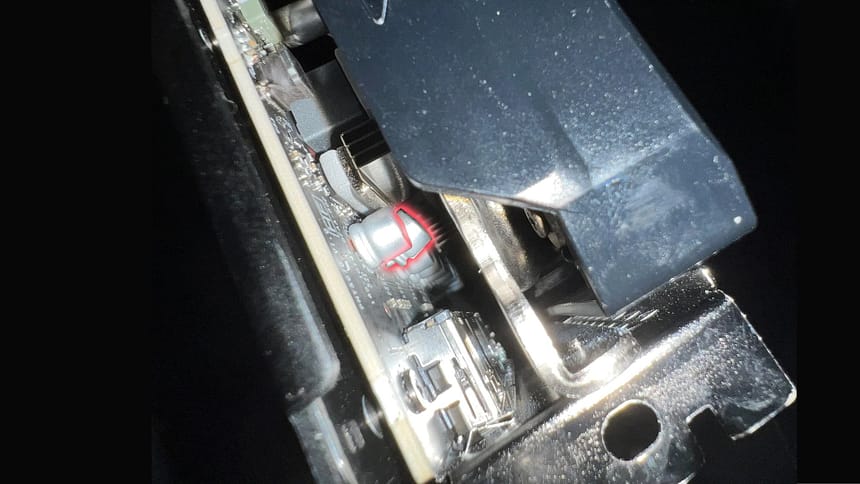
There is something off about PNY’s RTX 50 series GPUs. Even though we have only two reports, but no other capacitor explosions from other AIBs saw capacitor explosion till now.
Capacitor On PNY RTX 5070 Explodes While Playing a Game; The Second Such Incident Reported in a Week
Exploding capacitors are rare, but it’s the first time we are seeing such incidents happen in a span of just a few days. Just four days ago, a user reported a blown capacitor on his PNY RTX 5090 ARGB OC edition, which was probably the first such case reported on an RTX 50 series GPU. Exploding capacitors do happen, but they are extremely rare. In just a few days, another case emerged, and this time the victim is a GeForce RTX 5070 from PNY.
The Redditor u/Wujushu didn’t reveal the exact model, but we know that all four editions utilize a similar heatsink. According to the user, he heard a loud pop from his PC when he was playing Marvel Rivals. The incident left a burning smell, and he found a capacitor blown off its position. As you can see, it’s pretty much similar to the PNY RTX 5090 capacitor explosion. The difference is that both GPUs have a different heatsink design, and unlike the PNY RTX 5090 ARGB OC, the blown capacitor on the RTX 5070 doesn’t look to be in contact with the heatsink at all.

It appears that there is around 1cm gap between the capacitor and the heatsink, which is sufficient, but this seems like a poor solder or a bad capacitor. The capacitor appears to be near the I/O. So, these are near the chokes/inductors and are part of the VRM power delivery system. It seems that this capacitor couldn’t handle the load and exploded.
The interesting part is that the GPU was still working even after this incident, so the PCB didn’t take much damage to interfere with the operation. However, a higher load will now be distributed across the intact capacitors. The user has initiated the RMA process, but the issue of a poor-quality capacitor and inadequate quality checks remains. This incident is unlikely to be due to overheating, and it appears that the same issue could have occurred with the PNY RTX 5090. Interestingly, one user reported in the thread that he saw a similar case with his GeForce RTX 4070 Ti Super GPU, but it was from ZOTAC. However, there are no such reports on the RTX 50 series at the moment.

